Marooned in the Copland Valley
I didn’t mean to become marooned in the Copland Valley.
At least, not in the dramatic, windswept, isolated sort of way the word suggests. There was no shipwreck. No SOS scratched into river stones. No desperate attempt to survive on berries and rainwater while waiting for rescue.
But there was isolation.
And there was weather.
And there was me — eighteen kilometres into one of the wildest valleys on the West Coast of New Zealand, living without internet, without phone reception, and without any real idea of whether I was genuinely brave or simply too stubborn to back out after saying yes.
The opportunity arrived innocently enough.
Six months earlier I had seen an advertisement for a Hut Warden position at Welcome Flat Hut, tucked deep within the Copland Valley inside Westland Tai Poutini National Park, on the rugged West coast of the South Island of New Zealand. Most people applied for one or two week stints. I applied, encouraged wholeheartedly by my friend who, unlike me, seemed to possess an unwavering belief in my ability to throw myself into situations that terrified me.
I submitted the application with equal parts excitement and dread.
At the time, I had never tramped eighteen kilometres solo into unfamiliar country. I had never worked remotely in the bush. I had never been responsible for a backcountry hut full of strangers.
Naturally, this seemed like an excellent idea.
A few days later I received a reply explaining all positions for the season had been filled, but would I like to go onto a cancellation list?
Of course, I said yes.
Nervously.
Then life carried on and the idea drifted quietly into the background until, one month before departure, an email arrived.
Could I fill a ten-day block?
Holy moley.
I accepted before I could talk myself out of it.
That final week before leaving was emotionally exhausting. Excitement and trepidation wrestled constantly inside me like two feral cats fighting in a sack.
I overthought everything. Food. Clothing. Wet weather gear. Whether I packed too much. Whether I packed too little. Whether I would look like a complete idiot. Whether I would cry halfway in and need rescuing by helicopter.
My partner in life, meanwhile, remained maddeningly calm.
He never once suggested I shouldn’t go.
He never once mirrored my fear.
Instead, he simply believed in me.
Perhaps more than I believed in myself.
The night before the walk in, I barely slept.
I sat in Fox Glacier with my pack exploded across the room around me while trying to finalise food for the next week and a half. There was no internet at Welcome Flat. No reception. No quick trip to the supermarket. Whatever I carried or had flown in beforehand was what I had.
I remember lying there thinking about the word solo.
Solo tramp.
Solo job.
Solo decision making.
There would be nobody else to lean on.
Part of me remembered an older version of myself. A confident version. A capable woman who once charged headfirst into challenges without dissecting every possible outcome beforehand.
Another part of me hesitated before every move.
Sleep eventually won.
Morning came quickly.
And at 8:30am I was dropped at the start of the Copland Track.
No turning back now.
Within fifty metres I found my first obstacle.
A river crossing.
Rough Creek surged noisily in front of me while the carpark still sat visible behind. I walked up and down the bank trying to decide where to cross while ugly little tentacles of doubt began creeping into my thoughts.
Then an angel’s voice sounded in my head.
“Choose the rocks carefully.”
“Don’t worry about getting your feet wet.”
“And go.”
So I did.
Standing safely on the opposite side, I looked back at where I had hesitated only minutes before and realised something important.
I was going to be okay.
More than okay.
The valley rewarded me immediately.
Snow clung to the mountain tops beneath skies so blue they looked freshly painted. The air was crisp but the sun carried surprising warmth and before long I was peeling off layers and trying unsuccessfully to jam them into my already overstuffed pack.
The bush itself felt ancient.
Towering moss-covered rata trees lined the track while tui sang invisibly overhead. Small streams threaded through the forest floor like silver veins and every so often the track opened to reveal glimpses of the Copland River.
Then came the kereru.
I didn't see it sitting quietly beside the track.
What I did experience was an explosion.
Wings thundered beside my head as the massive New Zealand wood pigeon launched itself from a nearby branch with all the subtlety of a helicopter crash. I nearly died of fright. The bird probably thought it had too.
After that, I remained considerably more alert.
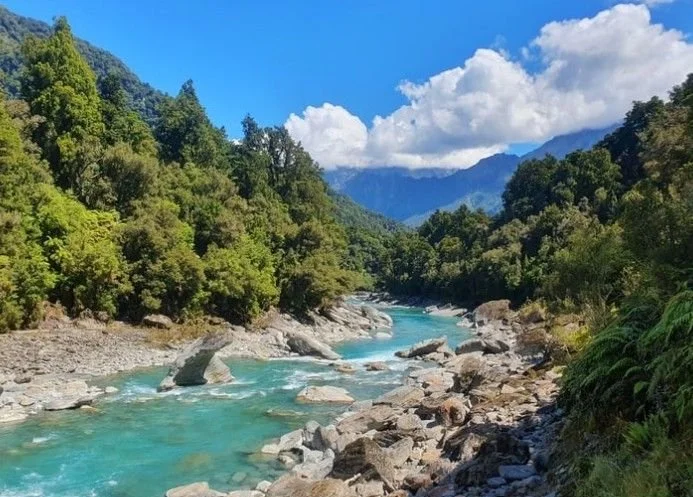
Five kilometres in, the Copland Track met the Copland River itself and the sight genuinely stole my breath.
The water was impossibly blue.
Not ordinary river blue.
Glacial blue.
A swirling, luminous aqua flowing violently around smooth schist boulders beneath the towering Sierra Range. The river looked simultaneously angry and peaceful, wild yet deliberate.
I stood there mesmerised.
For seven hours I walked.
I crossed bridges, creeks and active landslides. I climbed over roots and boulders and somehow, miraculously, never fell over once.
My knees, however, staged a violent protest.
Pain spread through both legs and into my hips until the final few kilometres became an exercise in pure stubbornness.
Just keep moving.
One foot in front of the other.
Nearly there.
When I finally reached Welcome Flat around 3:30pm, exhausted and limping, I was greeted by the outgoing hut wardens — a retired couple who had spent fifty years tramping, drinking wine and clearly mastering life.
They took one look at my gait and sternly ordered me into the hot pools.
I did not require any further prodding.
The Welcome Flat hot springs are difficult to describe properly because no description seems adequate.
The geothermal pools sit beside the Copland River beneath the towering Sierra Range as if carefully designed by someone determined to create the perfect wilderness sanctuary.
At the source, the water emerges from the earth at fifty-seven degrees Celsius.
Boiling.
Scalding.
Untouchable.
Further downstream the pools are cooled and managed into temperatures between twenty-five and forty degrees.
I sank gratefully into the hottest one I could bare.
The pain in my legs dissolved almost instantly.
Steam drifted into alpine air while waterfalls spilled from distant cliffs and snow clung to mountain faces above me. It felt prehistoric somehow, as though dinosaurs should have wandered casually from the bushline.
That first soak changed something.
The fear began loosening its grip.
The following mornings quickly formed a ritual.
Before sunrise I would pull on my bikini, crocs and flanno before hobbling through the freezing air toward the pools. At one degree Celsius the cold bit hard enough to sting exposed skin, but the reward waiting in the water made every shiver worthwhile.
Each dawn unfolded like theatre.
Sunlight would slowly kiss the top of Mount Glorious before stretching across the Sierra Range. Grey warblers began the morning chorus before bellbirds, tui, fantails and tomtits joined in until the valley vibrated with birdsong.
Sitting there waist deep in geothermal water while steam rose around me and mountains glowed pink with sunrise felt surreal.
Time behaved differently in the valley.
It stretched.
Or perhaps disappeared altogether.
Back home, life moved according to clocks, deadlines, messages and obligations.
At Welcome Flat there was only weather, light, guests and the rhythm of the valley itself.
My daily tasks were simple.
Clean the hut.
Sweep floors.
Wipe mattresses.
Clean the toilets.
Empty rubbish.
Stock firewood.
Complete radio calls.
Welcome arriving trampers.
Deliver safety talks.
Collect hut fees.
Then the day belonged to me.
And what a place to exist freely.
I wandered the valley endlessly.
Crossing the 1918 swing bridge felt like stepping deeper into another century. Beyond it the valley opened magnificently beneath the Aurora, Sierra and Banks Ranges.
One afternoon, distracted by beauty, I wandered entirely off track.
Rather than panic, I unpacked my paper map and compass and attempted to triangulate my position using mountain peaks.
Orientate map.
Shoot bearing.
Convert magnetic to grid.
Draw lines.
Find triangle.
When the lines intersected successfully and revealed my approximate position, I nearly burst with pride.
There, in the middle of a remote alpine valley, I had proven something quietly important to myself.
I was more capable than fear allowed me to believe.
Visitors came and went constantly.
Young backpackers bubbled with excitement while soaking in the pools, sharing stories about van life and future adventures across Australia. Hunters arrived with weathered faces and binoculars. Couples trudged into camp exhausted and emotional after the long walk.
Everyone carried their own journey into the valley.
And for brief moments our paths crossed.
Then evening would fall and silence reclaimed the place.
Not empty silence.
Living silence.
The river babbled endlessly.
Wind moved through forest canopies.
The fireplace crackled and settled.
Fantails tapped at windows hunting sandflies.
Somewhere beyond the darkness rocks shifted and avalanches rumbled unseen down mountain faces.
The valley itself seemed alive.
I began photographing every chance I could muster.
Moonlit landscapes.
Clouds wrapping seductively around mountain peaks.
Rain on river stones.
Waterfalls bursting from cliffs after storms.
At four or five in the morning I would stumble half asleep from my bunk carrying tripod and camera toward the river, desperate to capture the valley before dawn fully arrived.
One morning under moonlight the mountains glowed silver while the river whispered through darkness beneath stars so bright they seemed close enough to touch.
I stood there with frozen fingers feeling impossibly small.
Yet strangely peaceful.
Then the weather arrived.
Real West Coast weather.
Rain settled into the valley with grim determination.
The Department of Conservation closed the track.
Heavy rainfall transformed the turquoise Copland River into a roaring murky green torrent while waterfalls multiplied across every cliff face.
The isolation deepened immediately.
No guests arrived.
No one left.
For days it rained continuously.
The mountains disappeared behind cloud.
Avalanches thundered invisibly through fog.
And for the first time since arriving, nervousness crept back in.
I was due to walk out eventually.
The track crossed active slips and swollen creeks.
Every distant rumble reminded me that this landscape, beautiful as it was, remained utterly indifferent to human plans.
Still, even during the storm, the valley mesmerised me.
The rain changed its voice.
Changed the colour of the river.
Changed the mood of the mountains.
Everything responded to weather as though the valley itself breathed.
Unable to venture far, I filled my days with books, writing and history.
I read about Charles Douglas — the legendary explorer who mapped much of South Westland alongside his faithful dog Betsey Jane.
I read about the Graham brothers guiding tourists and mountaineers across the Copland Pass.
I read about the brutal labour required to carve and maintain the original track through slips, floods and dense bush.
And I became fascinated by the women.
Jane Thompson.
Constance Barnicoat.
Freda du Faur.
Women who climbed mountains and crossed alpine passes at a time when society still argued over whether women belonged in the wilderness at all.
Reading their stories while sitting alone in the Copland Valley during heavy rain felt strangely intimate.
These women had walked this country long before modern gear, modern tracks or modern comforts.
And they had done it anyway.
Perhaps courage is rarely the absence of fear.
Perhaps it is simply movement despite it.
By Day Seven I realised something else.
The isolation had changed me.
Not dramatically.
Not in some cinematic, life-altering way.
But quietly.
Subtly.
Without internet or constant distraction, my thoughts slowed enough to hear themselves properly.
I worked out on the hut floor to burn nervous energy.
I drank endless cups of tea.
I read entire books in single sittings.
I listened to avalanches hidden inside cloud.
And somewhere during those rain-soaked days I stopped feeling trapped.
Instead, I began feeling privileged.
Privileged to witness a valley that most people only ever glimpse briefly.
Privileged to experience solitude without loneliness.
Privileged to realise I could exist independently in a place that once terrified me.
The Copland Valley stripped life back to basics.
Warmth.
Shelter.
Water.
Movement.
Weather.
Connection.
Silence.
And perhaps that was the point.
Not to conquer fear.
Not to prove anything grand.
But simply to remember that beneath all the noise of modern life there remains something deeply human about sitting quietly beside a wild river while mountains disappear into cloud.
Even now, years later, I can still hear the valley.
The river.
The rain.
The distant avalanche rumbling unseen through fog.
And somewhere among it all, a quiet voice saying:
You’re okay.
More than okay.